EN
EN



Environmental Challenges to Photoelectric Sensor Stability
How dust, mist, and steam disrupt photoelectric sensor performance
Dust and other airborne particles really mess with how well photoelectric sensors work. Some factory tests found that when dust builds up over time, it can block as much as half the light passing through in bad situations. The problem gets worse with things like fine mist which actually bounces infrared beams all over the place, causing sensors to go off when they shouldn't. Steam is another troublemaker because it forms condensation on lenses that changes how light bends through them. That's why many top sensor makers have started adding special air purging systems these days. These systems create a sort of barrier of clean air around the sensitive parts, keeping dust and moisture from getting inside where they cause problems.
The effect of bright ambient light on signal interference in photoelectric sensors
Bright ambient light from sources like direct sunlight or industrial equipment such as welding torches can really mess with sensor LEDs, making it harder for them to distinguish actual signals from background noise. Factory sensors placed close to welding areas or glass manufacturing equipment often face problems where their error rate jumps by around 30 percent because of this kind of light pollution. To combat these issues, newer systems incorporate techniques that involve varying light frequencies and special filters that block out unwanted wavelengths. These approaches help maintain accurate readings even when working under harsh lighting conditions that would typically interfere with standard sensors.
Moisture and condensation: hidden threats to sensor reliability
Humidity exceeding 85% RH promotes lens fogging and accelerates internal PCB corrosion. A 2023 field analysis found sensors in food processing plants required 40% more maintenance when exposed to daily washdowns compared to controlled settings. Hermetic sealing and hydrophobic coatings are now essential for achieving IP69K compliance in high-moisture applications.
Trend: increasing use of protective housings and air purging systems
Demand for NEMA 4X-rated sensor enclosures has risen 55% year-over-year across industrial automation. Constructed from stainless steel or polycarbonate, these housings feature moisture-wicking breather valves and compressed air nozzles that preserve optical clarity in dusty or humid environments.
Case study: sensor failure in high-humidity industrial environments
A packaging facility using standard diffuse sensors experienced 12 false triggers per hour during monsoon season. After switching to pressurized sensors with heated lenses, annual downtime dropped from 18% to 2%. While energy costs increased by $0.12 per unit, the change yielded $18,000 in annual maintenance savings.
Target Properties and Their Impact on Detection Accuracy
Impact of Object Color and Reflectivity on Photoelectric Sensor Response
Surface color and reflectivity directly influence detection accuracy. Black surfaces reflect only 15% of incident light, compared to 85% for white surfaces (Optical Engineering Society, 2023), creating challenges in automated sorting. Field data indicates 40% of industrial misreads involve low-reflectivity materials, underscoring the need for tailored sensor selection.
How Surface Texture and Shape Affect Light Reflection and Detection Stability
Textured surfaces scatter light diffusely, while curved geometries deflect reflections away from receivers. Controlled tests show a 2 mm-radius curve reduces effective detection range by 40% versus flat targets. To account for real-world variability, manufacturers now calibrate sensors using sandblasted metal test pieces that simulate common surface irregularities.
Challenges in Detecting Small or Irregularly Shaped Targets
Small objects measuring less than 5 mm or those with complicated forms, like mesh filters for instance, typically escape detection because they sit beneath what the sensor can actually resolve. Studies indicate that problems with detection jump around three times higher whenever something takes up less than a quarter of the sensor's viewing area. The field has seen progress though, particularly with newer methods for spotting tiny items. Techniques such as adaptive thresholding now help manufacturers spot these miniature parts during production processes where precision matters most.
Data Insight: 40% of Misreads Linked to Low-Reflectivity Black Surfaces
Industry surveys confirm dark materials are responsible for nearly half of detection errors in packaging and automotive sectors. Standard sensors struggle with light absorption at intensities below 1500 lux, prompting development of high-gain models optimized for carbon fiber, rubber, and other low-reflectance materials.
Strategy: Selecting Optimal Sensor Modes Based on Target Properties
Modern photoelectric sensors offer six to eight detection modes to accommodate material diversity. Retroreflective sensors perform well with matte surfaces, while polarized variants handle shiny objects effectively. For translucent materials like glass, through-beam sensors with 50 kHz modulation achieve 99.8% accuracy in bottling applications.
Key Technologies Enhancing Photoelectric Sensor Stability
Triangulation-Based Background Suppression in Diffuse Photoelectric Sensors
Advanced diffuse sensors use triangulation to distinguish targets from background surfaces. By analyzing the angle of reflected light, these systems dynamically adjust detection thresholds, suppressing interference from conveyor belts or machinery. This enables stable detection of matte or inconsistently positioned objects without manual recalibration.
Diode Array Systems for Precise Distance-Based Object Detection
Diode array sensors utilize multiple receiver elements to create dynamic detection zones. Unlike single-diode models, they analyze spatial light patterns to calculate object position with greater accuracy. A 2022 industrial study showed these sensors reduced positioning errors by 62% in packaging lines compared to conventional designs.
Time-of-Flight Technology and Its Role in Long-Range Stability
Time-of-flight (TOF) sensors calculate distance by measuring the round-trip duration of light pulses, enabling millimeter-precision measurements over distances up to 150 meters. Unlike ultrasonic alternatives, TOF remains stable across temperature fluctuations. Advanced signal processing allows these sensors to maintain <3% measurement variance even under variable outdoor lighting.
Pulse-Modulated vs. Unmodulated Light in Photoelectric Sensors
Pulse-modulated infrared systems emit coded light patterns that resist ambient interference, outperforming continuous-wave (unmodulated) sensors. In welding environments, modulated sensors report 83% fewer false triggers. This capability ensures reliable operation in areas flooded with fluorescent or natural light.
Excess Gain and Performance in Contaminated Operating Conditions
Understanding Excess Gain and Its Critical Role in Dirty Environments
Excess gain is basically extra light energy that stays in reserve within a sensor after it passes the minimum level needed for detection. This spare capacity helps when signals start dropping due to common issues like dust buildup, oil mist interference, or just old lenses getting worse over time. Research into how light travels through these systems shows that sensors packing plenty of excess gain can keep working even when light levels drop by as much as 97%. That kind of resilience makes such sensors absolutely essential in tough industrial environments where conditions are rarely ideal.
Data Point: Sensors With >3x Excess Gain Maintain 95% Uptime in Dusty Areas
Field data from 143 manufacturing sites (2023 Industrial Automation Report) reveal a strong correlation between excess gain and reliability:
| Parameter | ≥3x Gain Performance | <3x Gain Performance |
|---|---|---|
| Monthly false triggers | 2.1 incidents | 17.8 incidents |
| Contamination failures | 5% of installations | 34% of installations |
| Maintenance cycles | 18-month intervals | 3-month intervals |
These findings highlight how excess gain reduces total cost of ownership in contaminated environments.
Strategy: Calculating Required Excess Gain Based on Environmental Severity
To determine optimal excess gain:
- Measure contaminant density (particles/cm³) using ISO 8573-1 air purity standards
- Analyze particle size distribution (0.1–40 micron range)
- Assess exposure frequency (continuous vs. intermittent)
- Apply a safety factor of 1.5–3x for unpredictable conditions
For example, a wood processing plant with 8,000 particles/cm³ (>10 micron sawdust) requires 4x excess gain to maintain <1% annual failure. Always validate calculations against manufacturer-provided environmental derating curves.
Selecting the Right Photoelectric Sensor Type for Stable Operation
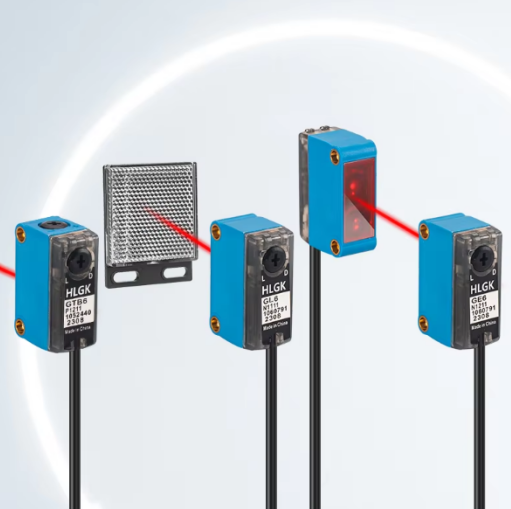
Through-beam sensors: highest stability with dual-unit configuration
Through beam sensors work with two parts: one sends out the signal, the other receives it. These setups can reliably detect objects across pretty long distances, sometimes as far as 60 meters away. What makes them stand out is how they only react when something actually blocks the beam path straight between the components. This helps cut down on accidental readings in places where there's lots going on around them, such as inside busy paper production facilities or near welding operations where sparks fly everywhere. Sure, getting those two parts aligned just right takes some effort during installation. But once set up properly, these sensors can pick up all sorts of stuff passing through including clear glass panels and even dull surfaced metal pieces. For this reason many industrial safety systems rely heavily on through beam technology when absolute accuracy matters most.
Retroreflective sensors: balance of range and installation ease
Retroreflective sensors combine the emitter and receiver into a single housing, with a reflector that sends light signals back toward the source. These devices can detect objects at distances of around 25 meters, which is pretty impressive considering how much easier they are to install compared to those bulky through-beam systems. That's why many factories use them for keeping track of items moving along conveyors or managing inventory in automated warehouses. The downside though? Dust and oil tend to mess with their performance quite a bit faster than what happens with traditional through-beam sensors. Factories dealing with messy conditions often find themselves cleaning these sensors more frequently or looking for alternative solutions when reliability becomes an issue.
Diffuse sensors and sensitivity to target and background variations
Diffuse sensors work by bouncing light off whatever object they're pointing at, so there's no need for those extra reflector parts hanging around. They fit nicely into tight spots such as robotic hand mechanisms, but come with their own set of issues. The sensor readings tend to fluctuate depending on how shiny or dull the surface happens to be. We've noticed that shiny stuff actually makes them detect things from farther away sometimes – maybe around 40% further than when dealing with rougher textures. And watch out for situations where what's behind the target doesn't stand out much either, because that tends to throw off the readings quite a bit and leads to all sorts of false alarms nobody wants.
Industry paradox: popularity of diffuse sensors despite lower stability
Despite lower inherent stability, 58% of manufacturing plants primarily deploy diffuse sensors (Industrial Automation Report, 2023). This preference stems from lower installation costs and adaptability to irregular targets—such as textile bundles or rubber gaskets—where mounting reflectors is impractical.
Visible red, infrared, and laser light: trade-offs in detection precision
- Visible red light: Enables visual alignment but performs poorly in sunlit areas
- Infrared: Resists ambient light interference but complicates diagnostics without oscilloscopes
- Laser-based: Delivers ±0.1mm precision for semiconductor handling but fails in fog or steam
Emerging multi-spectrum sensors use environmental feedback to automatically switch wavelengths, enhancing stability across changing conditions.
Table of Contents
-
Environmental Challenges to Photoelectric Sensor Stability
- How dust, mist, and steam disrupt photoelectric sensor performance
- The effect of bright ambient light on signal interference in photoelectric sensors
- Moisture and condensation: hidden threats to sensor reliability
- Trend: increasing use of protective housings and air purging systems
- Case study: sensor failure in high-humidity industrial environments
-
Target Properties and Their Impact on Detection Accuracy
- Impact of Object Color and Reflectivity on Photoelectric Sensor Response
- How Surface Texture and Shape Affect Light Reflection and Detection Stability
- Challenges in Detecting Small or Irregularly Shaped Targets
- Data Insight: 40% of Misreads Linked to Low-Reflectivity Black Surfaces
- Strategy: Selecting Optimal Sensor Modes Based on Target Properties
- Key Technologies Enhancing Photoelectric Sensor Stability
- Excess Gain and Performance in Contaminated Operating Conditions
-
Selecting the Right Photoelectric Sensor Type for Stable Operation
- Through-beam sensors: highest stability with dual-unit configuration
- Retroreflective sensors: balance of range and installation ease
- Diffuse sensors and sensitivity to target and background variations
- Industry paradox: popularity of diffuse sensors despite lower stability
- Visible red, infrared, and laser light: trade-offs in detection precision