EN
EN



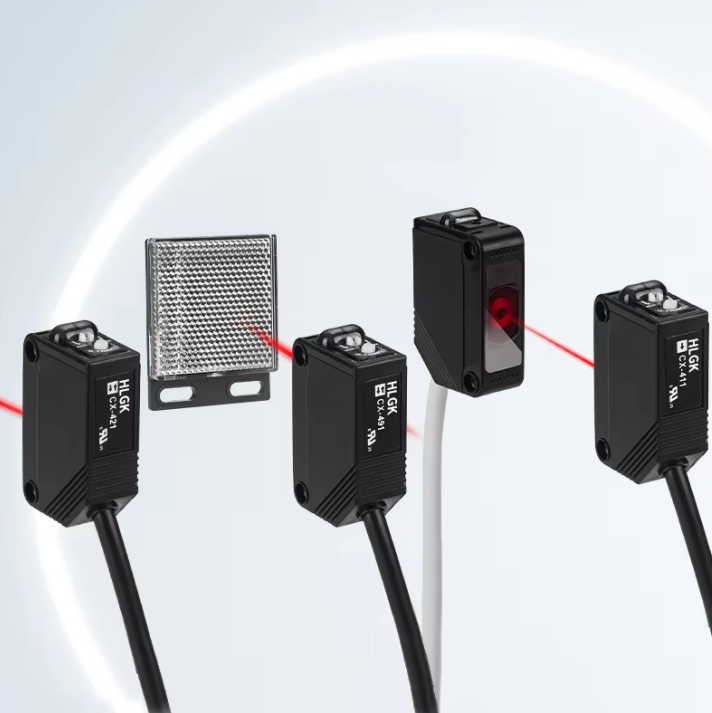
Understanding Photoelectric Sensors and Their Role in Industrial Automation
What Are Photoelectric Sensors and How Do They Work?
Photoelectric sensors work by using light beams, usually infrared ones, to spot objects without actually touching them. Most of these gadgets have three main parts working together: there's the light source that sends out the beam, then the part that catches the light when it comes back, and finally some sort of circuitry that processes what happens next. Basically, whenever something gets in the way of the light or bounces it back, the sensor knows something is there and sends out a signal. On those super fast packaging lines where everything needs to move smoothly, these sensors can react in less than a millisecond, which means they can keep track of stuff moving past at over a thousand items every single minute. Since they don't need any physical contact, they're great for places where cleanliness matters a lot or where machines just can't afford to wear down too quickly from constant touching.
Core Components of Sensor-Based Automation Systems
Modern sensor-based automation relies on four critical elements:
- Light transmitters: Generate consistent, adjustable beams for precise detection
- Receivers: Convert light patterns into electrical signals
- Signal processors: Analyze inputs using programmable thresholds
- Integration interfaces: Communicate with PLCs (Programmable Logic Controllers) and SCADA systems
These components work together to enable tasks like conveyor belt synchronization and robotic arm positioning. For example, in automotive assembly, aligned sensor arrays achieve positional accuracy within ±0.2 mm, reducing part misalignment by 92% compared to mechanical switches (Ponemon 2023).
The Foundation of Smart Manufacturing with Photoelectric Sensors
Photoelectric sensors give manufacturers instant feedback about how their production lines are running, which helps them spot problems before they become major issues and fine tune operations as needed. Factories that have integrated these sensors into their Industrial Internet of Things setups typically experience around 30% fewer unexpected shutdowns and see throughput increase by roughly 18%. What makes these sensors really valuable is that they work seamlessly with vision inspection systems and RFID tracking technology, creating complete visibility across the entire manufacturing chain something that's becoming essential in today's smart factory environments. Some recent studies show that when companies invest in this kind of automated monitoring system, they often get their money back within about 14 months just from cutting down on material waste and saving energy costs alone.
Boosting Production Efficiency Through Non-Contact Detection
Non-Contact Operation Reduces Mechanical Wear and Maintenance Downtime
Photoelectric sensors work without touching what they detect, so there's no wear and tear from friction. Systems using these sensors experience around 37% less unexpected downtime than traditional mechanical ones according to Future Market Insights data from last year. The way these sensors measure things optically means they don't spread particles around, which is really important in food packaging and medicine manufacturing where cleanliness matters most. This fits right into what Industry 4.0 demands about keeping processes tightly controlled from start to finish.
High-Speed Detection Maintains Throughput in Dynamic Environments
Advanced photoelectric sensors achieve response times under 1 ms, enabling real-time production control even in high-speed bottling lines exceeding 600 units/minute. Laser-based variants demonstrate ±0.05% accuracy in conveyor synchronization, as detailed in real-time production control research. This capability prevents bottlenecks in automotive assembly plants where robotic arms require millimeter-precise part positioning.
Case Study: Minimizing Downtime in Packaging Lines
A mid-sized consumer goods manufacturer implemented photoelectric sensors across 12 packaging stations, achieving:
- 40% reduction in jam-related stoppages
- 15% higher line output due to improved detection consistency
- 22 fewer maintenance hours/month thanks to contamination-resistant housings
Enabling Predictive Maintenance with Real-Time Sensor Data
Integrated photoelectric systems generate actionable insights through continuous performance monitoring. By analyzing intensity fluctuations in reflected light beams, facilities can predict lens contamination 8–12 hours before failure thresholds. This data-driven approach reduces corrective maintenance costs by 30% in sheet metal processing applications (Ponemon 2023).
Achieving High Precision and Reliability in Automated Processes
High Accuracy in Object Positioning Enhances Assembly Consistency
Photoelectric sensors can detect objects with incredible precision at the micron level, which really matters when trying to keep assembly lines consistent. Take automotive manufacturing for instance these sensors hit positional accuracy around plus or minus 0.1 mm. That's way better than old school mechanical limit switches according to that Industrial Automation Report from last year. The difference? About 72 fewer misalignment problems. When robots install parts on cars, this kind of accuracy makes sure things like those tiny electrical connectors fit just right and that all those safety critical bolts are tightened properly without any slop. It's not just about perfection it's about preventing recalls down the road.
Long-Range Detection Supports Large-Scale Factory Automation
Today's photoelectric sensors have broken past those old range limits thanks to better lasers and improved receiver tech. Some models can detect objects from as far as 50 meters away, which means one sensor can watch an entire warehouse aisle instead of having multiple ones scattered around everywhere. No more blind spots when moving materials around then. The cost savings are pretty impressive too. Warehouses that distribute auto parts saw their sensor installation expenses drop about 40 percent according to Logistics Tech Journal last year. Makes sense really, fewer sensors needed but still full coverage.
Laser vs. LED: Evaluating Sensor Types for Precision Applications
While LED-based sensors dominate general-purpose applications, laser variants offer superior performance in precision-critical environments. Automotive quality control stations using laser sensors achieve a 99.4% defect detection rate, compared to 97.1% for LED models (Optical Engineering Quarterly 2023). Coherent light beams provide sharper detection edges, crucial when verifying sub-millimeter component clearances.
Real-World Performance: 99.8% Detection Accuracy in Automotive Robotics
Leading automotive manufacturers report 99.8% detection accuracy in robotic welding cells, as documented in a 2024 precision engineering study. This reliability comes from dual-axis alignment verification, where sensors cross-validate part positions before critical operations, reducing rework costs by $740k annually in mid-sized plants (Automotive Manufacturing Review 2024).
Key Applications in Conveyor, Packaging, and Robotic Systems
Object Detection in Conveyor and Packaging Lines Ensures Smooth Material Flow
Photoelectric sensors work really well for spotting objects on conveyor belts, which stops those annoying bottlenecks during fast paced packaging processes. These sensors can tell where products are located and spot any gaps as things move along, keeping materials flowing smoothly at speeds around 2000 items per hour. The market for automated packaging solutions looks pretty big too, with estimates suggesting it might hit nearly $10 billion by mid next decade. That's why so many factories are turning to through beam sensors and retro reflective models these days. They let operators deal with all sorts of different package shapes and sizes without having to constantly tweak machinery settings manually.
Precision Positioning in Robotic Assembly Using Real-Time Feedback
Robotic grippers equipped with photoelectric sensors achieve positioning accuracy within ±0.1 mm in assembly tasks. In automotive component production, this reduces misalignment errors by 73% compared to manual methods. Sensors provide continuous feedback to robotic controllers, enabling dynamic adjustments during high-speed pick-and-place operations.
Integrating Photoelectric Sensors with PLCs for Coordinated Control
Advanced integration with modern industrial control systems allows photoelectric sensors to synchronize with Programmable Logic Controllers (PLCs) in complex automation sequences. This coordination enables real-time response to line speed variations while maintaining detection reliability across temperature fluctuations from -25°C to +70°C.
Case Study: 32% Efficiency Gain in an Automated Bottling Line
A 2024 implementation study demonstrated how diffused photoelectric sensors reduced false triggers in a beverage bottling facility. By implementing sensors with adjustable detection ranges, the plant achieved a 32% throughput increase and eliminated 18 hours/month of downtime previously caused by label misalignment errors.
Driving Cost Savings, Quality Control, and Operational Safety
Reducing Scrap Rates and Improving Profitability with Sensor Accuracy
Photoelectric sensors minimize production errors by detecting misaligned components with ±0.2 mm precision, reducing material waste by up to 18% in assembly processes (Manufacturing Efficiency Report 2024). Their ability to distinguish between metallic and non-metallic objects ensures accurate sorting, lowering scrap costs in industries like automotive parts manufacturing.
ROI Insights: Payback Period Under 14 Months in Mid-Sized Facilities
A 2023 analysis of 72 manufacturing sites revealed that integrating photoelectric sensors with PLC systems delivered 23% faster cycle times and full ROI within 11–14 months. Energy savings from reduced false triggers contributed to $58k annual operational cost reductions in packaging plants.
Enhancing Quality Control and Early Error Detection in Production
Real-time monitoring via photoelectric sensors identifies deviations in product dimensions 400ms faster than mechanical limit switches. This early fault detection prevents cascading defects, improving first-pass yield rates by 14% in electronics assembly applications.
Ensuring Worker Safety with Reliable Safety Interlocks and Machine Guarding
With detection ranges up to 50 meters, photoelectric sensors enable fail-safe machine shutdowns when workers enter hazardous zones. Facilities using infrared variants report 92% fewer safety incidents compared to traditional light curtain systems.
Combining Photoelectric Sensors with SCADA and Vision Systems for Full Traceability
When paired with supervisory control and data acquisition (SCADA) software, these sensors provide timestamped production data across 97% of assembly stages. This integration supports ISO 9001 compliance by creating audit-ready records of material handling accuracy.
Table of Contents
- Understanding Photoelectric Sensors and Their Role in Industrial Automation
- Boosting Production Efficiency Through Non-Contact Detection
- Achieving High Precision and Reliability in Automated Processes
- Key Applications in Conveyor, Packaging, and Robotic Systems
-
Driving Cost Savings, Quality Control, and Operational Safety
- Reducing Scrap Rates and Improving Profitability with Sensor Accuracy
- ROI Insights: Payback Period Under 14 Months in Mid-Sized Facilities
- Enhancing Quality Control and Early Error Detection in Production
- Ensuring Worker Safety with Reliable Safety Interlocks and Machine Guarding
- Combining Photoelectric Sensors with SCADA and Vision Systems for Full Traceability