EN
EN



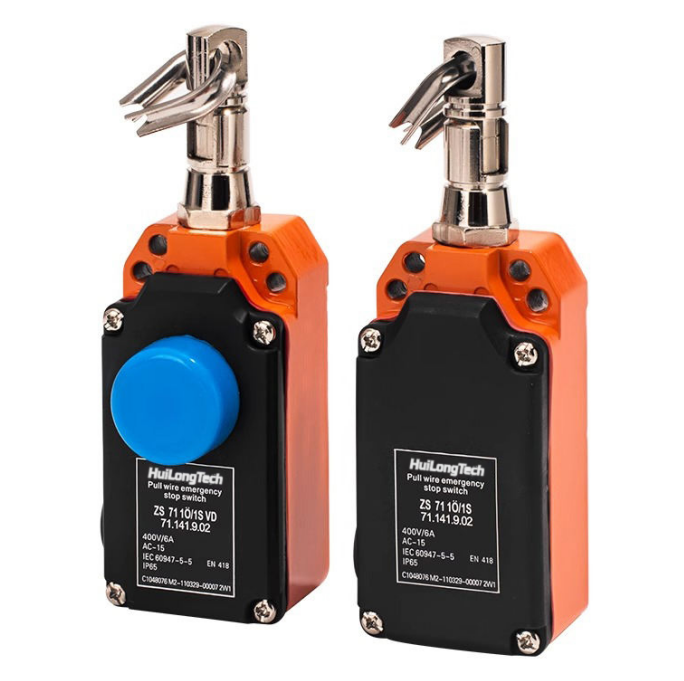
Core Safety Function: How the Emergency Stop Safety Rope Switch Triggers Immediate Shutdown
Pull-activated circuit interruption: tension-based actuation and fail-safe breaking
Emergency stop safety rope switches work by physically stopping machines when pulled. If the tension goes over 150 Newtons, which is what ISO 13850 specifies as maximum safe force, then a spring loaded part inside cuts off the safety circuit right away. What makes these devices so reliable is that they don't rely on any computer controls at all. There's absolutely no delay from electronics getting in the way. And here's something important about their design: if the rope gets cut, parts break, or there's just not enough tension anymore, the machine shuts down automatically. These switches don't need electricity to function either, so they keep working even when power goes out. Factories have tested them extensively and found that they stop operations in under half a second. That kind of quick response time can make all the difference in preventing serious accidents on those fast moving conveyor belts we see in manufacturing plants every day.
Latching mechanism and controlled reset protocol for safe restart
Once turned on, the system uses a locking mechanism to keep the circuit open until someone intentionally resets it. Workers need to physically turn the actuator or put in a key, but only after making sure all hazards are cleared first this stops things from accidentally starting back up. To reset properly, they have to follow steps in order: unlock first, check there's no tension on the rope, then actually perform the reset. These safety steps match what's required by ANSI Z535.4 standards for critical control systems. Industry audits show these procedures cut down on restart accidents by about three quarters, which makes a real difference in workplace safety.
Fail-Safe Engineering: Mechanical Integrity and Redundancy in the Emergency Stop Safety Rope Switch
Critical components—rope, actuator, contacts—and ISO 13850-compliant trip force thresholds
Emergency stop safety rope switches built for industrial applications typically include three main components that work together to ensure safety: first, stainless steel wire ropes capable of handling over 1500 pounds of tension; second, actuators designed to withstand impacts; and third, contacts made from silver alloy that clean themselves automatically. These components function within the parameters set by ISO 13850 standards, specifically the required trip force range between 50 and 150 Newtons. This ensures that the system activates reliably even when faced with typical workplace conditions. For added protection against failures, these switches incorporate redundant contact blocks connected in series. If somehow the main contacts get stuck together during electrical faults of up to 10 amps, backup contacts kick in to keep the circuit open, preventing dangerous situations from developing.
| Component | Fail-Safe Feature | ISO 13850 Requirement |
|---|---|---|
| Wire Rope | Corrosion-resistant steel core | Min. 1,000 N break strength |
| Actuator | Over-travel protection | 50—150 N trip force range |
| Contact Blocks | Dual NC (Normally Closed) circuits | Positive-opening operation |
Break-detection logic and loss-of-tension response for zero-risk failure modes
Today's rope switches come equipped with closed loop monitoring systems that spot broken cables or loose sections within just about 50 milliseconds. These devices use strain gauges to monitor when the tension goes outside normal ranges by plus or minus 15 percent. When this happens, safety relays kick in to cut off power before dangerous situations get worse. What happens if the tension falls under 40 Newtons? That usually means the cable is sagging, disconnected, or partially failed somewhere. At that point, magnetic latching mechanisms stop the system from restarting automatically. Someone has to manually check everything first before operations can resume safely. Most modern setups have dual channel architecture built right in. This lets signals get checked against each other through programmable logic controllers, which cuts down on false alarms while still keeping things completely safe according to industry standards. Facilities really benefit from all these features because studies show that catching problems early saves them around seven hundred forty thousand dollars worth of unexpected shutdown costs every year according to research published by Ponemon Institute back in 2023.
Real-World Application: Deploying the Emergency Stop Safety Rope Switch on Conveyors and Linear Machinery
Long conveyor belts and linear machinery that stretch across entire factory floors or warehouse spaces need quick emergency responses throughout these large workspaces. Standard push buttons just don't cut it when workers can't get to those fixed control points fast enough during emergencies such as stuck materials or tangled products. That's where emergency stop rope switches come into play. Workers can pull anywhere along the hanging cable to shut things down immediately, breaking the safety circuit right away. No need to run around installing expensive wiring for dozens of separate buttons, plus people react much faster this way. Recent OSHA numbers from 2023 show these rope switches cut down on delayed emergency responses by about 85% compared to old fashioned stops, which helps avoid serious accidents like getting crushed or caught between moving parts. These safety ropes fit naturally alongside production lines, package handling systems, and automatic transfer mechanisms, creating protection all along the line without gaps.
Standards Compliance and System Integration of the Emergency Stop Safety Rope Switch
Mandatory certifications: IEC 60947-5-5, EN 60204-1, and OSHA/ANSI alignment
Meeting international standards is essential for ensuring that emergency stop safety rope switches actually perform as intended in real world conditions. Standards like IEC 60947-5-5 set specific rules about how emergency switches should work under pressure. Then there's EN 60204-1 which looks at electrical safety across all types of machinery. On the regulatory front, OSHA regulations found in 29 CFR 1910.212 along with ANSI B11.19-2019 are pretty strict about making sure power gets cut off instantly when someone enters a dangerous area. All these different guidelines come together to create a comprehensive safety net that manufacturers must follow if they want their products to be approved for industrial use.
| Standard | Key Requirement | Enforcement Scope |
|---|---|---|
| IEC 60204-1 | Category 0 stop (no controlled deceleration) | Global manufacturing |
| NFPA 79-2021 | Override all other controls | Industrial machinery |
| OSHA 1910.212 | Immediate power cutoff | U.S. workplaces |
Third-party validation confirms fail-safe operation under ISO 13850 tension thresholds and prevents accidental reactivation. Non-compliance risks penalties exceeding $145,000 per violation (OSHA 2023).
Seamless integration with safety relays, PLCs, and industrial control architectures
Emergency stop safety rope switches work right alongside safety relays to set up those backup circuits that actually stop machines in under 150 milliseconds when needed. The dry contact outputs plug straight into PLCs, so they can be integrated into control systems without causing any signal problems. When it comes to safety protocols, we're talking about standards like CIP Safety and PROFIsafe which make sure everything communicates properly and quickly across different parts of the network. What this all means is that operators can monitor how tight those ropes are staying from one central location, all while keeping things at the high safety level required by SIL 3 or PLe ratings. Getting the setup right keeps the emergency system separate from regular controls, so when something goes wrong, the machine stops first every time without fail.
Table of Contents
- Core Safety Function: How the Emergency Stop Safety Rope Switch Triggers Immediate Shutdown
- Fail-Safe Engineering: Mechanical Integrity and Redundancy in the Emergency Stop Safety Rope Switch
- Real-World Application: Deploying the Emergency Stop Safety Rope Switch on Conveyors and Linear Machinery
- Standards Compliance and System Integration of the Emergency Stop Safety Rope Switch